
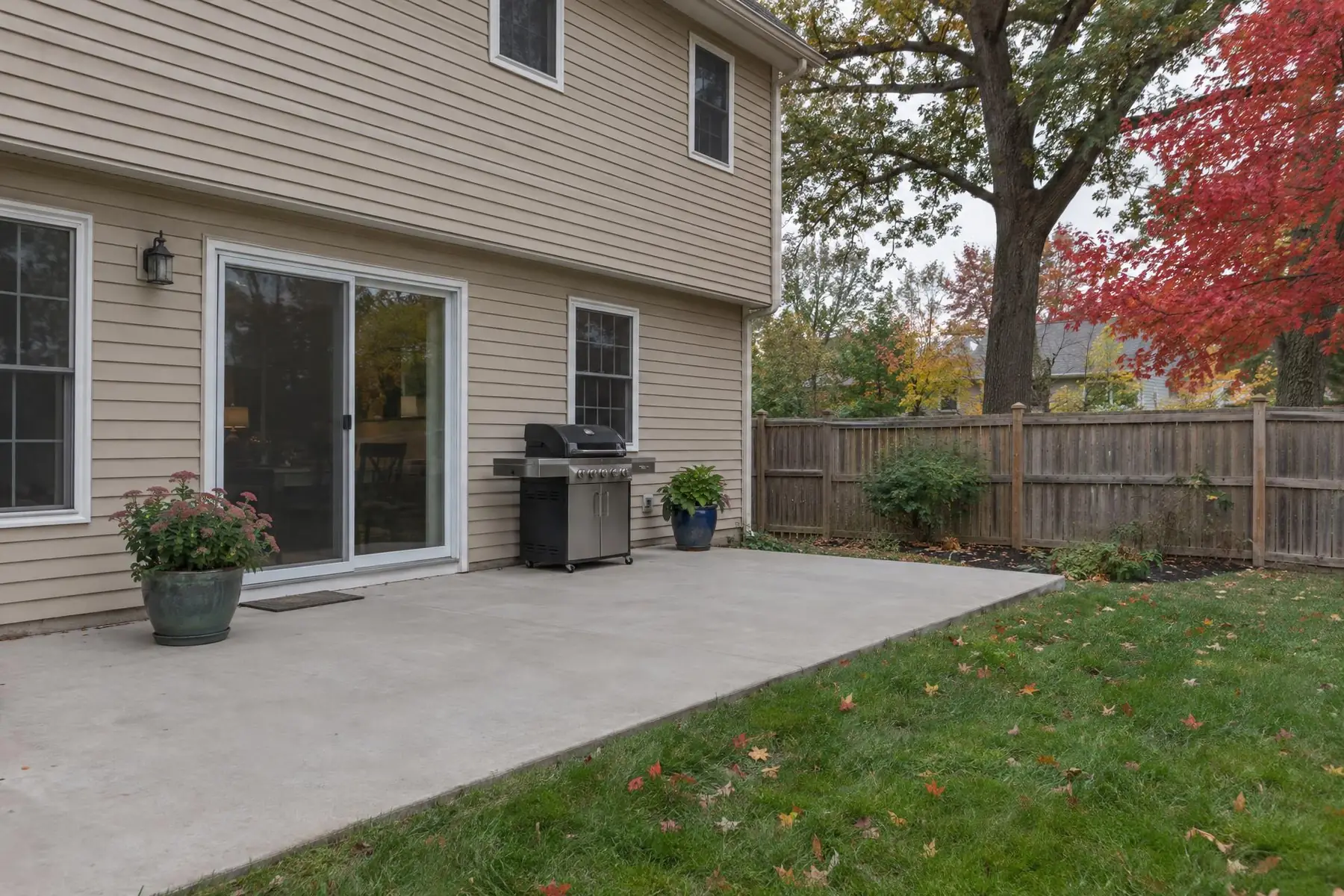
Smooth broom-finished concrete patio behind a sided house with a grill, potted plant and wood fence

Concrete Patio Hamilton New Jersey: Concrete Patio Installation and Patio Resurfacing

Professional Concrete Patio Installation and Patio Resurfacing in Hamilton, NJ and Mercer County

Hamilton Concrete pours a concrete patio that gives a Hamilton Township, NJ backyard a level, solid surface for a dining set, a grill or a fire pit. Our concrete patio installation covers new patios, extensions of an existing slab and patio resurfacing for a worn one, in Hamilton Square, Mercerville, Yardville and across Mercer County. You end up with a patio that sheds rain away from the house and keeps its surface through a freezing winter.

Why homeowners choose us:

  • NJ-registered home improvement contractor
  • 20+ years pouring concrete across Mercer County
  • Permits handled we file the township application and schedule the inspections
  • Free written estimates with every line of the price broken out

The crew behind every patio has 20+ years of concrete work in Mercer County, and each slab is built on a compacted stone base with sawn joints. Your free written estimate lists the tear-out, base, concrete and finish line by line. We pitch each slab away from the foundation, because that is where most backyard water damage begins.

Get a FREE Concrete Quote

What Concrete Patio Installation Involves in Hamilton, NJ

A patio looks simple, but the layers under the surface decide whether it stays flat for decades. Every patio we pour in Hamilton includes the steps below, whether it is a new slab, an extension of an old one or a replacement for broken concrete:

  • Layout and pitch fix the size, the shape and the slope, so water runs off the slab and into the lawn instead of toward the house wall.
  • Tear-out removes an old patio or clears the sod, which leaves a clean, level starting point.
  • Stone base is graded and compacted under the slab, and it keeps the patio from settling in the first wet spring.
  • Forms hold the edges, the thickness and the shape while the concrete is placed.
  • Reinforcement adds wire mesh or rebar, which keeps a crack tight if the ground moves.
  • The pour goes down continuously, so the surface has no cold seams where water can get in.
  • Finish is broom, smooth trowel, colored or stamped, chosen to match how you use the space.
  • Saw-cut joints steer shrinkage cracks into straight, tight lines instead of letting them wander.

Signs You Need a New Concrete Patio in Hamilton

When a Hamilton Patio Needs Replacing or Resurfacing

  • Flaking and pitting means salt and freezing have worn the top layer, and it gets rougher each winter.
  • Cracks that run through the slab let meltwater under the concrete, where it freezes and pushes the patio out of level.
  • A slab that tilts toward the house sends rain against the foundation, and the tilt usually means the base has settled.
  • Standing water after rain shows the slab was poured too flat, and puddles that freeze make the surface slick.
  • A stained, worn surface on solid concrete is a candidate for patio resurfacing, which costs less than pouring new.

Why Patios Are Harder on Hamilton Winters

Freezing and Thawing

Hamilton Square gets about 47.5 inches of rain and 23.9 inches of snow a year, and January nights average 23.7°F. Water that soaks into a slab expands as it freezes, and a patio goes through that cycle many times a winter. Concrete that cannot drain holds the water longer, so the pitch and the base matter as much as the mix. A slab that looks dry in November can have a wet base underneath, and the first hard freeze is when that water does its work. February nights average 25.1°F, so the freezing season runs well past January.

Salt and De-Icers

Scaling, the flaking that leaves a patio rough, is caused by physical salt attack on the surface. High-strength, low-permeability, air-entrained concrete at 4,000 psi or more is what resists it. Calcium chloride is less aggressive on concrete than rock salt, and de-icers that contain ammonium nitrate or sulfate, which are fertilizer products, react with almost all concrete and should never be used.

Drainage Under and Around the Slab

Effective drainage that carries water out from under a pavement slows frost damage. Mercer County lies across the Inner Coastal Plain and the Piedmont, and Hamilton Township sits on the Coastal Plain side. We look at how water leaves each yard before we set the pitch, so the slab drains toward the lawn and not toward the house. A patio that drains well in July can still pond in March, when the ground is frozen and rain has nowhere to soak in.

How Much Does a Concrete Patio Cost in Hamilton, NJ?

A plain broom-finished concrete patio in Hamilton costs about $8 to $15 per square foot. That is the same range as a plain driveway, because the base, the slab and the finish are the same. Removing an old slab first adds roughly $1 per square foot, and a stamped finish costs more, at about $15 to $25 per square foot. Size, thickness, excavation, reinforcement and finish move a patio within those ranges. Patio resurfacing is priced after we look at the old slab, since it only suits concrete that is still solid underneath.

Our Concrete Patio Process in Hamilton, NJ

Four stages take a patio from a measured yard to furniture on a finished slab.

1. Yard Visit and Layout

We walk the yard, measure the space and look at how water moves across it. You choose the size, the shape and the finish, and we mark the pitch. The free written estimate that follows lists the tear-out, the base, the concrete and the finish, so you can compare it against any other quote line by line.

2. Tear-Out and Base

Any old patio is broken out and hauled away, and the ground is graded and compacted under a crushed stone base. This is the stage that decides whether the finished slab stays flat, so the base is finished before the forms go in, never after. A thin or uneven base shows up later as a patio that rocks underfoot, and that is a mistake only a full replacement can fix.

3. Forms and Pour

The forms go in with the thickness and the pitch, reinforcement goes in under the slab and the concrete is placed in one pass. The crew screeds the surface to the pitch as it goes down, so the slope is set while the concrete is still workable. We do not pour when freezing is expected, because concrete exposed to a freeze without protection can be damaged beyond saving and has to come out.

4. Finish, Cure and First Use

The finish goes on while the concrete is workable, and the joints are sawn once it can take them. Foot traffic is fine at 24 to 48 hours, and the patio reaches full strength at 28 days, which is when a heavy grill or planter should go back on it. The same crew pours concrete steps to match, and our stamped concrete work covers patterned finishes.

Concrete Patios FAQs: Hamilton, NJ

How much does a concrete patio cost in Hamilton, NJ?

Expect about $8 to $15 per square foot for a plain broom-finished patio in Hamilton. Removing an old slab adds roughly $1 per square foot, and a stamped finish runs about $15 to $25 per square foot.

What finishes are available for a concrete patio?

Finishes include broom, smooth trowel, colored and stamped. A broom finish gives the most grip when wet, trowel suits covered areas and stamped concrete presses a brick, slate or stone pattern into the surface.

How do you keep a patio from draining toward the house?

The slab is pitched away from the foundation and poured on a compacted stone base. We look at how water leaves the yard before setting the slope, so the runoff goes into the lawn and away from the house wall.

How long before I can use a new concrete patio?

Foot traffic is fine after 24 to 48 hours. Furniture and heavy items such as a grill should wait until the concrete reaches full strength at 28 days, and the edges cure last.

Can an old concrete patio be resurfaced instead of replaced?

Resurfacing works when the old slab is still solid, level and free of deep cracks, and it only fixes the surface. A slab that has sunk or crumbles through its depth needs replacing instead.

Why does my patio flake in winter?

Water in the surface expands when it freezes, and road salt or de-icer pulls more water in. The top layer then scales off. Air-entrained concrete at 4,000 psi resists it, and calcium chloride is gentler on concrete than rock salt.

Can a new patio connect to my existing slab?

A new patio can be poured against an existing slab and tied to it, as long as the old concrete is sound. We check the old slab during the visit, and we replace it if it has sunk or cracked through.

Can concrete be poured in cold weather in Hamilton?

Hamilton Township requires concrete that is exposed to a freeze without approved protection to be removed and replaced, so pours are scheduled for weather that stays above freezing.

Hamilton Concrete serves Hamilton and Mercer County.

Get a Free Concrete Patios Quote in Hamilton, NJ

(609) 307-2735 Get a Free Quote